
Home Renovations in Melbourne
Most renovations start smaller than they finish
Almost nobody rings a builder wanting a whole-house renovation. They ring about the kitchen. Then it turns out the kitchen doesn’t work because the wall behind it is in the wrong place, and moving that wall means the bathroom has to shift, and once the bathroom shifts you may as well look at the laundry.
That’s not a builder upselling. It’s what happens when you take an honest look at a house that was laid out for how people lived in 1935 and try to make it work for how you live now.
A home renovation done well works out where the real problem is before deciding what to build. Sometimes that’s one room. Sometimes it’s the whole floor plan. We’ll tell you which, and if the answer is “just do the kitchen”, that’s what we’ll quote.
Get a free consultation
Step
of 2
We use your details only to respond to this enquiry. Read our
Privacy Policy.
What we renovate
Kitchen renovations
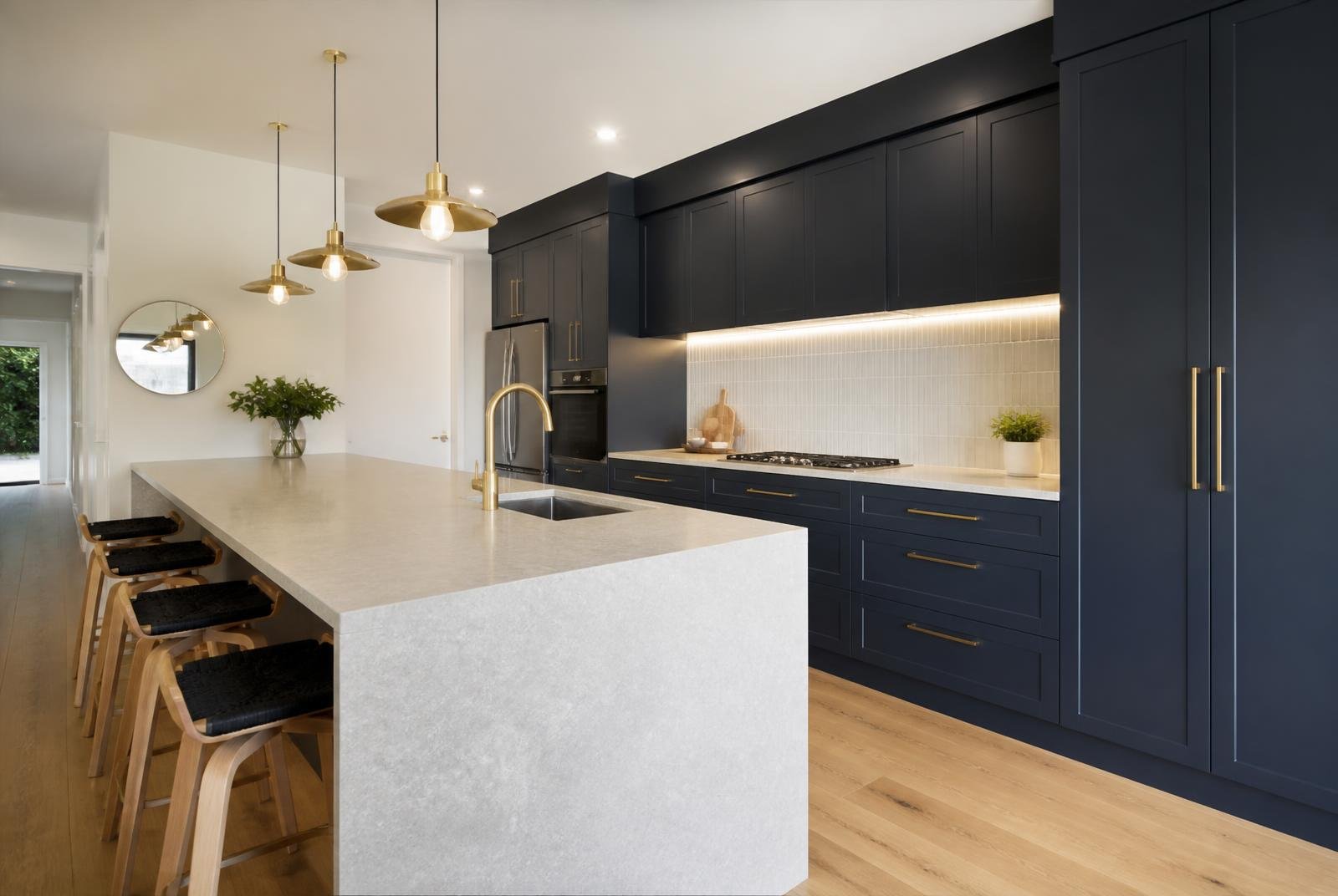
Custom Melbourne-made joinery, stone benchtops and a layout that finally works for the way you cook. See our kitchen renovations page.
Bathroom renovations
Waterproofed to AS 3740, tiled properly, finished by licensed trades. Small bathrooms and ensuites a speciality. See our bathroom renovations page.
House extensions
Rear, side and second-storey additions where the renovation needs more floor area than the existing footprint allows. See our house extensions page.
Whole-home renovations
Where the floor plan itself is the problem. Covered in detail below.
Accessibility modifications
Home modifications and SDA work as an NDIS-approved builder. See our NDIS and SDA homes page.
Whole-home and full house renovations
A full home renovation is the right call when the problems aren’t confined to one room. Usually that means one or more of the following: the floor plan puts living areas on the wrong side of the house, the wet areas are all failing at once, services are at end of life across the whole building, or you’re dealing with a house that’s had three unsympathetic renovations bolted onto it over forty years.
Complete home renovations are also the most disruptive thing you can do short of demolishing. Most clients move out for at least part of it. That’s worth planning and budgeting for at the start rather than discovering in month four.
What we typically cover in a whole-house job: reworked floor plan and structural changes, rewire and re-plumb, new kitchen, bathrooms and laundry, insulation and energy performance upgrades, flooring and joinery throughout, and external works where the exterior needs to catch up with the inside.
If the house is genuinely beyond saving — failing footings, poor orientation that can’t be fixed, a plan that resists every intervention — we’ll say so and talk to you about a knockdown rebuild instead. Renovating a fundamentally compromised house is the most common way people spend $600,000 and remain unhappy.
Period and heritage home renovations
Victorian and Edwardian homes
Single and double-fronted terraces and villas, usually in a heritage overlay through the inner north and inner east. Heritage home renovations generally keep and restore the street-facing rooms and put the new work at the rear. Expect to find lath and plaster, original joinery worth saving, timber stumps at end of life, and lead-based paint on anything original.
Californian bungalows and Federation homes
Through the inner east and bayside. Solid brick or brick veneer on shallow footings, generous blocks, and floor plans with too many small rooms and a kitchen at the back facing the wrong way. Usually the best candidates for a rear reconfiguration.
Weatherboard homes
Weatherboard home renovations across Melbourne’s north and west. Timber on stumps means re-stumping is common, floor levels have often moved, and the cladding may hide anything from good original boards to three layers of previous repairs. Also the easiest construction type to alter, which is why so much of Melbourne’s weatherboard stock has been extended badly at least once.
Art Deco and mid-century homes
Interwar and post-war stock with details worth keeping — curved walls, steel-framed windows, original terrazzo, clinker brick. The temptation is to strip it all out. The better result usually comes from restoring what’s characteristic and modernising what isn’t.
What does a home renovation cost in Melbourne?
A home renovation in Melbourne typically costs 2,000–3,500 per square metre for a cosmetic-to-moderate renovation, and 3,500–5,500 per square metre for a structural whole-home renovation. A full renovation of a 150 square metre home generally lands between $350,000 and $700,000, depending on how much of the structure and services you touch.
| Scope | Indicative range |
|---|---|
| Single room (kitchen or bathroom) | $20,000 – $70,000 |
| Multi-room renovation | $120,000 – $250,000 |
| Whole-home renovation (cosmetic to moderate) | $250,000 – $450,000 |
| Whole-home renovation (structural) | $450,000 – $800,000+ |
What moves the number most: how much structure you change, whether services need full replacement, the condition of what’s behind the walls, whether a planning permit is required, and finish level. On any pre-1960s Melbourne home, the honest answer is that nobody knows exactly what’s there until it’s opened up — which is why we build a contingency conversation into the quote rather than pretending otherwise.
Every quote we write is itemised. Variations are documented and approved in writing before work starts. The number you sign is the number you pay.
Where to start with a renovation
Stage 1 : Work out the actual problem
Renovation planning starts before design. What specifically doesn’t work about the house? Which of those things can be fixed by moving a wall, which need more floor area, and which are unfixable? Answering that honestly is what stops a renovation growing sideways.
Stage 2 : Feasibility
Title, planning scheme, overlays, easements, structure, soil and services. We assess what the house and the block will carry before you spend money on drawings.
Stage 3 : Design and documentation
Plans, structural engineering and energy rating, prepared and lodged for your building permit. Where a planning permit is needed, we prepare and manage that too.
Stage 4 : Approvals
Building permit
Issued by a registered building surveyor against the National Construction Code and the Building Regulations 2018.
Planning permit
Required where a Heritage Overlay, Neighbourhood Character Overlay or Significant Landscape Overlay applies, or where the design varies ResCode siting provisions.
What renovations trigger upgrade requirements
Altering or extending a home can trigger requirements that didn’t apply before — energy efficiency provisions on the altered parts, smoke alarm compliance, and wet-area waterproofing to current standard. Worth establishing at design rather than discovering at inspection.
Stage 5 : Construction
Staged so you can stay living at home where that’s possible, with a dedicated site supervisor, weekly photo updates and a live program.
Stage 6 : Handover
Structural warranty pack, insurance certificates, appliance documentation and a defects period, plus a walk-through where we go room by room.
How long does a home renovation take?
A single room is four to eight weeks. A multi-room renovation is three to five months on site. A whole-home renovation is typically six to twelve months of construction, plus three to five months of design, documentation and approvals at the front.
A planning permit adds three to six months, longer if a neighbour objects and it goes to VCAT. So a full home renovation on a heritage-overlay property is realistically eighteen months to two years door to door.
Where we renovate across Melbourne
01
Inner East Melbourne
larger blocks and period homes suited to whole-home renovations and second-storey additions. Hawthorn, Camberwell, Kew, Balwyn, Box Hill, Doncaster, Glen Iris and Surrey Hills.
02
Inner North Melbourne
heritage overlays, narrow blocks and Victorian terraces, where sympathetic renovation is our bread and butter. Brunswick, Coburg, Northcote, Preston, Fitzroy, Carlton, Thornbury and Reservoir.
03
Bayside & South East Melbourne
coastal exposure calls for durable cladding and glazing, and we build for salt air and southerly weather. Brighton, Bentleigh, Sandringham, Mentone, Cheltenham, Malvern, Caulfield and Frankston.
04
West & North West Melbourne
weatherboard stock through the inner west alongside newer homes further out. Footscray, Yarraville, Werribee, Point Cook, Sunshine, Essendon, Craigieburn and Melton.