
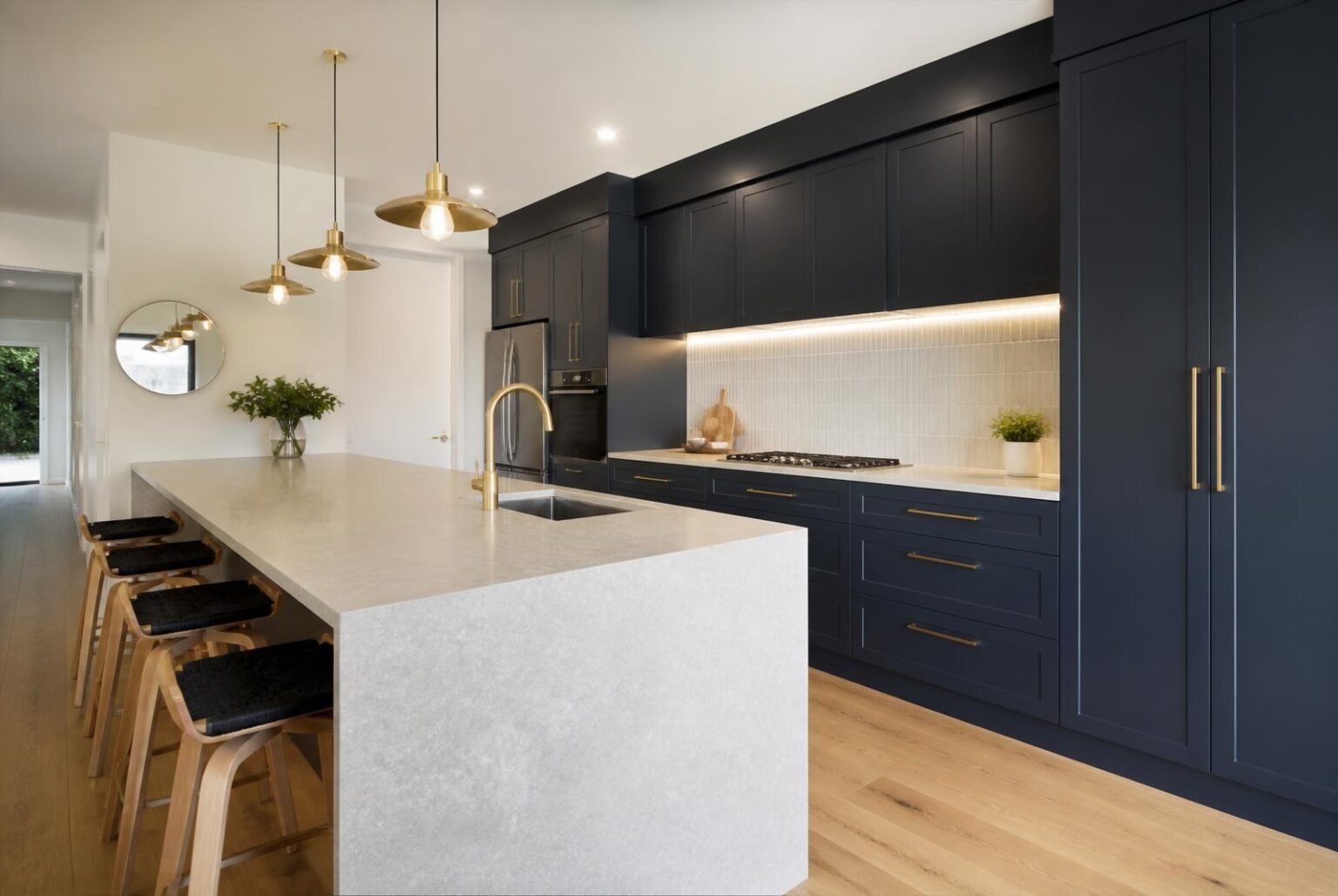
A kitchen renovation in Melbourne typically costs 20,000–35,000 for a small kitchen, 35,000–60,000 for a mid-range full renovation, and 60,000–120,000 or more for a large custom kitchen. Joinery and appliances usually account for more than half the total, which is why two kitchens the same size can differ by $40,000.
There’s a reason most builders won’t give you a number over the phone.
Two kitchens on the same street in Camberwell, both 12 square metres, both wanting an island and a stone benchtop, can come in $45,000 apart. One keeps the sink where it is. The other moves it to the island, which means running waste and water through a concrete slab, and suddenly you’re paying for a core drill and a plumber for three days instead of one.
So rather than a single figure that’ll be wrong for your kitchen, here’s how the money actually breaks down and what pushes it up.
Kitchen renovation costs at a glance
| Scope | Indicative range | What it covers |
|---|---|---|
| Kitchen makeover | $12,000 – $25,000 | New doors and drawer fronts, benchtop, splashback, tapware, paint |
| Small kitchen renovation | $20,000 – $35,000 | Full replacement, 4–8m², services stay where they are |
| Mid-range full renovation | $35,000 – $60,000 | New layout, custom joinery, some services relocated |
| Large custom kitchen | $60,000 – $120,000+ | Butler’s pantry, island, premium appliances, structural work |
These are build costs. They don’t include design, permits where structural work is involved, or the things people forget which we’ll come to.
As a rough rule, the average kitchen renovation cost in Melbourne lands somewhere around $45,000 for a full renovation of a standard family kitchen. But averages hide a lot. A 6-square-metre galley in a Brunswick terrace and a 20-square-metre open-plan kitchen in Balwyn are different projects with the same name.
Where the money actually goes
A useful way to think about it: in most full kitchen renovations, joinery and appliances are more than half the budget. Everything else — demolition, services, flooring, tiling, painting, benchtop installation — shares the rest.
That’s why the cheapest quote is often the most expensive one by the end. If someone comes in $15,000 under everyone else, the saving is almost certainly in the joinery or the appliance allowance, and you’ll find it at the selection stage.
Moving plumbing and electrical
The single biggest swing factor. Keeping the sink, cooktop and fridge roughly where they are keeps costs down and keeps the job short.
Moving the sink to an island means running waste and water through the floor. On a concrete slab that’s a core drill and a trench. On timber stumps it’s easier, but it still means lifting the floor and reworking under the house. Budget 3,000–8,000 for a meaningful services relocation, more if the layout changes substantially.
Benchtops
Natural stone, porcelain and sintered surfaces all sit at different price points, and across a typical kitchen the gap between the cheapest and dearest option is often $8,000 to $15,000.
One thing worth knowing: engineered stone benchtops were prohibited across Australia from 1 July 2024 following the national ban on manufacture, supply, processing and installation, because of the silicosis risk to stonemasons cutting it. If a quote you’re comparing still lists engineered stone, ask questions. ⚠️ Verify current status with your supplier before publishing.
Joinery: custom versus modular
Custom kitchen joinery made in Melbourne costs more than modular carcasses, and in an older home it’s worth it. In a 1930s bungalow or a Victorian terrace nothing is square — walls bow, floors fall, and a modular carcass leaves a 40mm scribe gap you can see from the doorway. Custom is the difference between built-in and dropped in.
In a newer home with true walls and a straightforward layout, modular can be a sensible saving. We quote both where it’s genuinely a choice rather than pretending custom is always the answer.
Appliances
Easy to underestimate. A full suite of premium European appliances can add $15,000 to $25,000 over mid-range equivalents in an otherwise identical kitchen.
Decide early, because appliance dimensions drive the joinery. Changing an oven selection after the cabinets are drawn means redrawing them.
Structural work
Removing a wall to open the kitchen into the living area means a beam, possibly a new post and footing, and a building permit. It’s the change that transforms how a house feels, and it needs an engineer. Budget 8,000–20,000 depending on the span and what the wall is carrying.
If you’re thinking about this, it’s worth reading our guide to house extensions too — sometimes the honest answer is that the kitchen needs more floor area than the existing footprint can give it.
How much does a small kitchen renovation cost?
A small kitchen renovation in Melbourne generally costs $20,000 to $35,000 for a full replacement, or $12,000 to $25,000 for a makeover that keeps the existing carcasses.
Small doesn’t mean cheap, and this catches people out. You still need the same trades — demolition, plumber, electrician, tiler, cabinetmaker, benchtop fabricator — and each of them still has a minimum call-out. The appliances cost what appliances cost regardless of the room.
Small kitchen renovations in Melbourne are also harder to get right, not easier. In four or five square metres every millimetre is contested and there’s no room to absorb a mistake. Full-height storage, drawers instead of cupboards, an unbroken benchtop run, and appliances chosen to fit the space rather than the space built around the appliances.
Done properly, a small kitchen changes how a terrace or a unit lives more than almost anything else you can spend the money on.
Can you do a budget kitchen renovation?
Yes, and there are honest ways to do it — plus a few that will cost you later.
What genuinely saves money
Keep the services where they are. The single biggest saving available. A new kitchen in the same layout can be thousands cheaper than the same kitchen rearranged.
Consider a makeover instead. If the layout works and the carcasses are sound, new doors, drawer fronts, benchtop, splashback and handles get you most of the visual change for a fraction of the cost. Kitchen makeovers in Melbourne typically run $12,000 to $25,000 against $35,000-plus for a full renovation.
Modular carcasses in a square house. In newer homes this is a genuine saving rather than a compromise.
Mid-range appliances. The performance gap between good mid-range and premium is much smaller than the price gap.
Simplify the benchtop. Fewer joins, fewer waterfall ends, a simpler edge profile. The material matters less than the fabrication complexity.
What to be careful about
Don’t cut the waterproofing or the electrical. Anything hidden that fails later costs multiples to fix.
Don’t buy appliances before the joinery is drawn. A bargain oven that doesn’t fit the cabinet isn’t a bargain.
Be wary of a quote with a large prime cost allowance for joinery. That’s not a fixed price, it’s an estimate with a signature on it. Ask what percentage of the contract sits in PC and PS items.
Affordable kitchen renovations in Melbourne are entirely achievable. The ones that go wrong are the ones where the saving came out of something you can’t see.
What’s not in the build cost
Build cost isn’t project cost. Set aside for:
- Design and documentation — layout, joinery drawings, and engineering if you’re removing a wall
- Building permit — required for structural work, not for a like-for-like replacement
- Appliances, if they’re not in the builder’s scope
- Flooring, if it runs beyond the kitchen footprint
- Painting beyond the kitchen walls, because new work makes old paint look old
- Eating out for three to five weeks, which costs more than people expect
- Contingency — 10% is sensible on any job in a house built before 1990
How long does a kitchen renovation take?
A kitchen renovation in Melbourne typically takes ten to sixteen weeks from first meeting to finished room, with three to five weeks of that being on-site disruption.
Design and joinery documentation runs three to five weeks. Joinery manufacture is a further four to six. On-site works are three to five weeks, including the one to two week gap between cabinet installation and the benchtop arriving — because benchtops are templated after the cabinets go in, not before.
That templating gap surprises everyone. You’ll have cabinets with no bench on them for a fortnight. It isn’t a delay; it’s how stone fabrication works.
Anyone quoting you a two-week kitchen is either using stock modular carcasses or hasn’t accounted for benchtop fabrication.
A realistic kitchen renovation timeline also depends on appliance lead times. If something’s on back-order, that becomes the critical path regardless of how fast the building goes.
Does a new kitchen add value?
Generally yes, in established Melbourne suburbs. A dated kitchen genuinely holds a sale price back, and buyers discount harder for a bad kitchen than they pay up for a good one.
But the sums differ depending on why you’re doing it. If you’re renovating to live in, spend what makes the room work for you. If you’re renovating to sell within twelve months, a well-executed makeover usually beats a full custom renovation on return — a $90,000 kitchen rarely returns $90,000 at auction.
We’re builders, not valuers. Talk to a local agent about your specific street before you budget on resale.
Getting a real number for your kitchen
Every figure in this article is a range, and ranges only get you so far. The number that matters is the one for your kitchen, your layout and your house.
At HRE Built we measure up properly, talk through how you actually cook, and work out where the sink, cooktop and fridge want to sit before anything else gets decided. Then you get an itemised fixed-price quote where the number you sign is the number you pay.
We’ve delivered 150+ projects across Melbourne over seven years, with custom Melbourne-made joinery on every kitchen we build.
See our kitchen renovation services Request a free consultation or call 0498 953 000
How to compare kitchen quotes
Three quotes on the same kitchen will come back at different numbers, and the cheapest is often the dearest by the end. What to look for:
Is it itemised? A quote saying “Kitchen — $52,000” tells you nothing. You want joinery, benchtop, appliances, tapware, splashback, flooring and trades listed separately, so you can see what you’re getting and where you could trim.
How much sits in prime cost and provisional sums? Legitimate tools, but a quote stuffed with them isn’t a fixed price.
Is the joinery custom or modular, and where is it made? “Australian-made” and “made in Melbourne” aren’t the same claim.
Who’s doing the trades? Licensed plumber and electrician, with certificates of compliance, isn’t optional.
How are variations handled? The answer should be: documented, priced and approved in writing before the work happens.
Getting a real number for your kitchen
Every figure in this article is a range, and ranges only get you so far. The number that matters is the one for your kitchen, your layout and your house.
At HRE Built we measure up properly, talk through how you actually cook, and work out where the sink, cooktop and fridge want to sit before anything else gets decided. Then you get an itemised fixed-price quote where the number you sign is the number you pay.
We’ve delivered 150+ projects across Melbourne over seven years, with custom Melbourne-made joinery on every kitchen we build.
See our kitchen renovation services Request a free consultation or call 0498 953 000
FAQ
How much does it cost to renovate a kitchen in Melbourne?
Typically $20,000 to $35,000 for a small kitchen, $35,000 to $60,000 for a mid-range full renovation, and $60,000 to $120,000 or more for a large custom kitchen. Joinery and appliances usually make up more than half the total.
How much does a small kitchen renovation cost?
Joinery, usually, followed by appliances and benchtops. Together they’re typically more than half the budget. The biggest avoidable cost is relocating plumbing, which can add thousands if the sink moves to an island.
Do I need a permit for a kitchen renovation?
Not usually for a like-for-like replacement in the existing footprint. You will need a building permit if you’re removing a load-bearing wall or altering the structure. Plumbing and electrical work must be done by licensed tradespeople and certified either way.
How long will I be without a kitchen?
Three to five weeks. We set up a temporary kitchen area with the fridge, kettle and microwave somewhere workable and seal off the work zone. Stock the freezer and accept you’ll eat more takeaway than usual.
Is kitchen remodeling in Melbourne cheaper than a full renovation?
If “remodeling” means keeping the layout and carcasses and replacing doors, benchtop and splashback, then yes — considerably. $12,000 to $25,000 against $35,000-plus. Whether it’s the right call depends on whether your problem is how the kitchen looks or how it works.
Should I renovate the kitchen before selling?
Often, but differently from renovating for yourself. A dated kitchen holds a sale price back, but a premium custom kitchen rarely returns its full cost at auction. Within twelve months of selling, a good makeover usually beats a full renovation on return.
Can I use an engineered stone benchtop?
No. Engineered stone was prohibited across Australia from 1 July 2024 because of the silicosis risk to stonemasons cutting it. Natural stone, porcelain and sintered surfaces cover the same range of looks and are all still available.